June 17, 2026
"The Shadow" in Otium
Every deliberation has a blind spot. Not because the voices are wrong — because the act of arguing any position requires looking away from something else. The more coherent the council, the more consistent that blind spot becomes.
The Shadow is not a voice. It doesn't argue or offer an opinion. It reads the shape of what the council produced and finds the region of the question that the entire deliberation — every voice, every steel man, every fracture — structurally avoided. Not what they disagreed on. What they all, together, could not reach.
It speaks once, at the end, after the Witness. It does not resolve anything. It names the thing being protected by keeping the question where it is.
Most people recognize it immediately. It is usually the thing they already knew but could not say.
Validation: The Shadow finds something real
We ran an independent test using eight philosophical traditions which were seeded as competing populations in a domain field shaped by the question. They expanded, competed for territory, and stabilized. We then read where no tradition reached.
Across eight independent stochastic runs, the gap consistently appeared in the same region of the philosophical map — stable despite random dynamics.
Otium's Shadow, computed through completely different mathematics, points at the same region.
The two systems share no logic. One uses energy functionals and phantom coupling. The other uses biological clone competition. They find the same gap because the gap is structurally determined by the council and the question — not by either system's design.
When the Shadow surfaces something in a Otium session, it is not generating a plausible insight. It is identifying a region that the philosophical traditions on your council structurally could not reach. The CA confirmed it independently.
Independent Validation Instrument - Deliberation Field Model
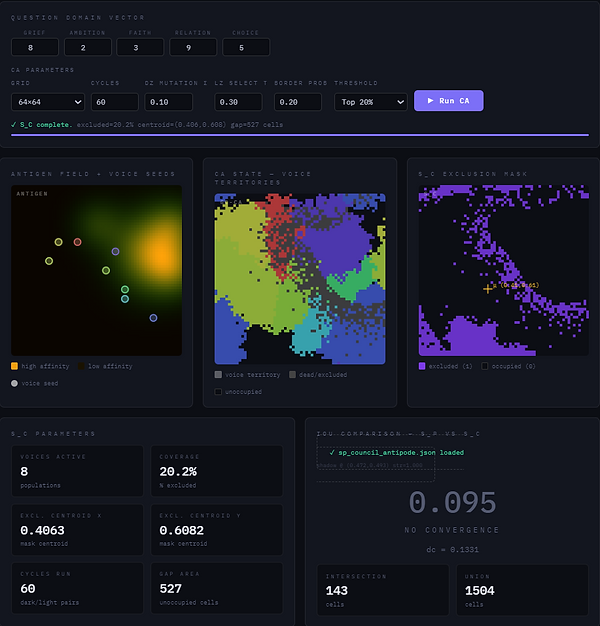
The validator was built to answer one question: does an independent system find the same gap the Shadow finds?
It does this by comparing two exclusion fields in the same coordinate space. One metric is centroid distance, which measures how far apart the centers of the two regions are. Across eight runs, the mean centroid distance was 0.114 in normalized field space, showing that both systems consistently pointed to nearly the same location.
The second metric is IoU, which measures how much the two binary masks overlap. IoU was lower, in the 0.089 to 0.095 range, because Otium’s Shadow is smooth and Gaussian while the CA produces a more irregular gap. That difference in shape is expected; what matters is that both systems converge on the same region.
In other words, centroid distance is the primary alignment signal, and IoU is the shape-consistency check. The CA found the same region Otium found, independently, over multiple runs.
June 1, 2026
The Deliberation Field
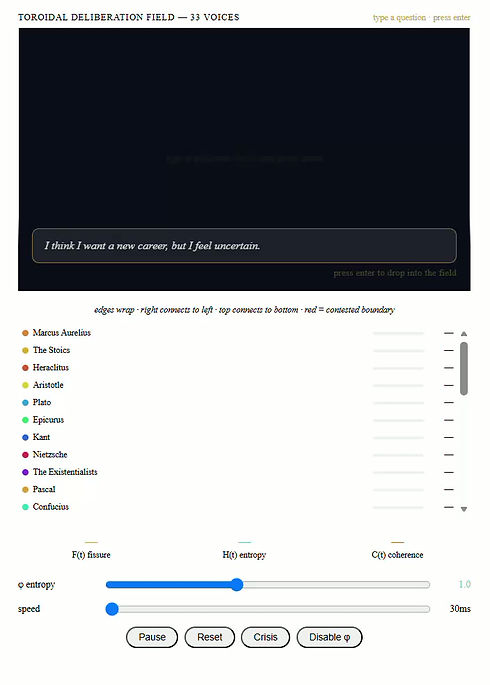
What you are watching is 33 voices — philosophers, sacred texts, and human archetypes drawn from across traditions and lived experience — competing for interpretive territory around a single question.
This is one small sample of a larger system — a philosophical deliberation engine.
Each colored region belongs to a voice. The boundaries between regions are where traditions contest the same ground — where Rumi and Ecclesiastes meet, where Marcus Aurelius and The Single Mother disagree about what the question is even asking. The darker the boundary, the more contested it is. That contested edge is where the hardest questions live.
When a new question drops in, the field reorganizes. Voices more resonant with what was asked take more territory. Voices with less to say recede to the periphery. The result is a map — not of the right answer, but of which frameworks have the most to say about what you are carrying.
The field wraps at every edge. What leaves the right side returns from the left. What leaves the top returns from the bottom.
There are no boundaries in the space of human interpretation — only territory that is more or less contested depending on where your question lands.
In the full system, these voices don't just compete for territory. They argue. They make their strongest case and name what that case cost them. A non-advocating Witness reads the geometry of the disagreement and returns not an answer but the question underneath the question — the one you cannot answer from where you currently stand without changing something fundamental.
Otium is currently in development for consumer release.
Patent Pending — April 2026